
By Caleb Michael Sarvis
"Barbershop"
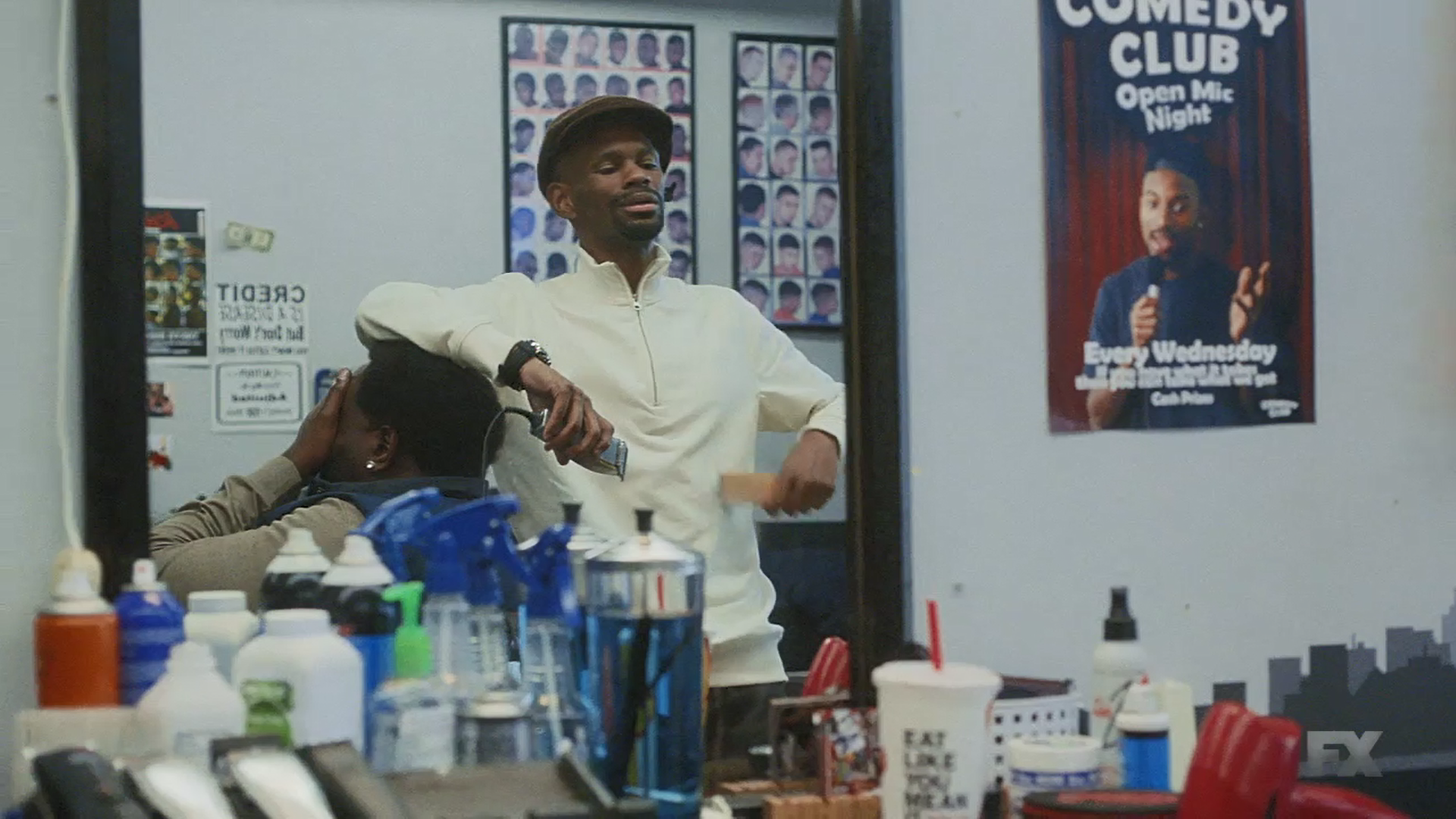
Alfred aka Paper Boi aka regular person needs a fresh cut before a photoshoot for a magazine profile. What does he do? He heads to Bibby, his trusted barber, the one who knows what Alfred means when he says, “the usual.” Alfred can’t allow another barber to touch his hair.
Only… Bibby is late. And he’s on the phone. And he has to show Alfred this funny video on his phone. And [wet emoji + peach emoji] is calling him, demanding his presence. And Bibby has to leave but brings Alfred along with the promise that he’ll finish the haircut at this woman’s house. And Bibby has to cut [wet emoji + peach emoji]’s son’s hair first, blaming Alfred for their tardiness. Says Alfred is a magician, that Bibby’s new-found Christianity pushed him to help Alfred.
In what’s become customary Atlanta DNA, our protagonist wants something easy, and is strung along for half an hour before they’re able to obtain it, if they do at all. Alfred needs to look fresh, to maintain his aura of fame, but Bibby is anything but helpful.
On Confines of Conceit
While there’s a lot at play here contextually, “Barbershop” doesn’t require any of it to work. The casual references to “Paper Boi” and “Hollywood” work well enough that the audience can jump in as first-time viewers.
This works, though, because the conceit doesn’t try too hard. Alfred needs a haircut, but his barber is a little sketch. That’s the pitch, and the rest of the story unfolds from there. I’m reading Hey Whipple, Squeeze This by Luke Sullivan. It’s common literature for those in the advertising world, but it also works as an outside-the-box approach to creative craft. In advertising, the simpler the idea, the better. Complexity is muddy, and you lose the essence of the ad in the process. Advertising has to be digested immediately, and while short stories aren’t exactly the same, there’s something to be said about first impressions. You want the reader to latch on somewhat quickly.
When the conceit is confined to that single sentence, writers control the essence while also giving the story room to grow. Ambition is a quality trait, but it’s partner-in-crime is our own ego, which is not good for story-telling. Ego gives our hand too much weight.
“Barbershop” works as well as it does because you can feel the scene build into the next. No mid-action cuts. No character-jumps. The story then unfolds through character, which are the kinds of stories I’m looking to read.
On Confines of Odyssey
“Barbershop” is a truncated odyssey in a way, which I understand is a little oxymoronic. Alfred arrives as he always does, only to be taken to a stranger’s home, then to a construction site, and offered leftover Zaxby’s (when he expected to go a real Zaxby’s). There Bibby tricks him into stealing some lumber, they are caught by the owner, and Bibby drives off despite threats to call the police. Bibby chases down some loitering teenagers because one of them is his son, Lamar. Bibby chastises Lamar as Alfred reminds him to keep his eyes on the road., and they rear-end a small woman. She steps out of the car, wails to the sky, and Bibby drives off once again.
All Alfred wanted was a haircut, and with each new stop he declares, “Bibby, I’m not playing with you, man,” and to get him back to the barbershop. What I found interesting about the storytelling here was that despite the multiple stops, and all the action in-between / at these stops, it all must have occurred within a ten-fifteen-mile radius of the barbershop. Everything “will take just five minutes” but Alfred loses an entire day because he’s without his own mode of transportation and is one stroke into a much-needed haircut.
Watching “Barbershop” reminded me that adventure can happen in small spaces, and as I struggle with this novel I’m working on, I am less compelled to put my character on the road. Big things can happen just a couple minutes away.
Two things working for me:
There’s a brief exchange between Lamar and Alfred. Lamar recognizes him as the “famous” rapper Paper Boi, but it confused as to why he doesn’t look “fresh.” Alfred, already upset with Lamar’s father, emerges from the car angrily and uses his bulky frame to intimidate the teenager, but doesn’t touch him. Instead he says, “I’m a regular person. Regular people get haircuts.” There’s a softness there in an otherwise tense scene that I really enjoyed. Bibby is a wonderfully infuriating character. He’s obliviously and unwaveringly selfish, yet each time he makes a stop, the audience is in-step with Alfred’s surprise and anger. That’s great for conflict. That’s great for emotionally-engaging storytelling.
Two things I’m not sold on:
Bibby is so fully-developed and authentic throughout the episode, that I have a tough time understanding why this is the go-to barber for Paper Boi. Obviously, this is who Bibby is, so why doesn’t Alfred recognize this? I imagine most visits are simple, but Alfred had to have known what he was getting into when he agreed to leave the barbershop in the first place. At the end of the episode, there are a couple other barbers in the shop that weren’t there before. Alfred reasonably walks past Bibby and sits in a different chair but can’t recall what the parameters of his usual cut. I really like this moment, but I’m still wondering where these guys were at the beginning of the episode and if Alfred is the famous regular that he is, wouldn’t they all know the “usual” at this point? This it nit-picky, but that’s just because the episode was great.
Caleb Michael Sarvis is a writer from Jacksonville, Florida. He is the author of Looney Purgatory or (i don’t have the stamina for that kind of faith) (Carbon Books 2018). He is the fiction editor for Bridge Eight Literary Magazine and received his MFA from the University of Tampa. His work has been featured in or is forthcoming from Hobart, Split Lip Magazine, Saw Palm, Panhandler Magazine, Eyeshot, and others. You can follow him on Twitter @calebmsarvis